
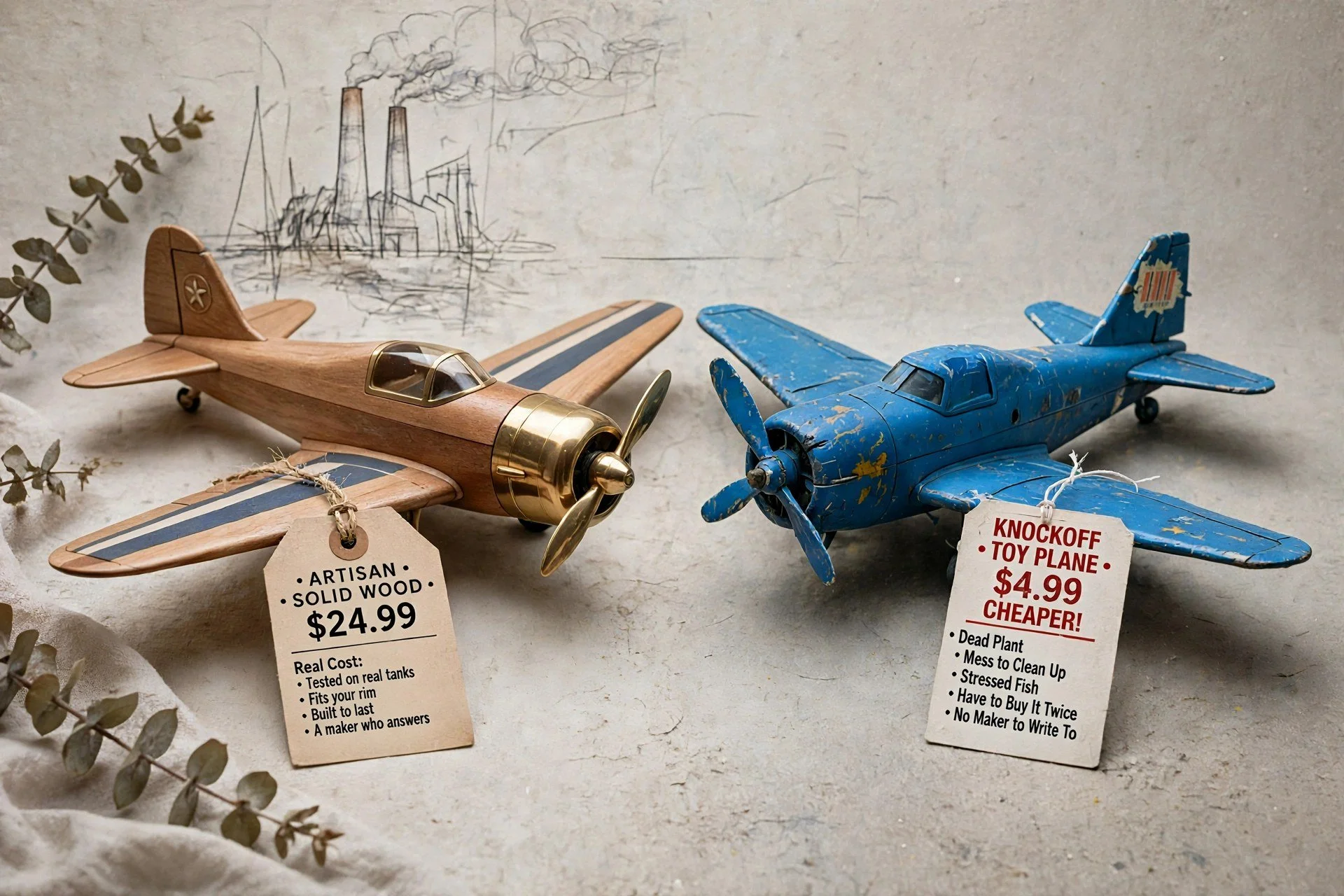
AI-generated illustration
If you've been shopping for a holder to grow plants out of your aquarium, you've seen them. Listings that look just like our holders, for half the price or less. Same shape, same idea, suspiciously cheap. I get why they're tempting. I also know what you're usually buying, because I've watched this play out since we started.
Where our designs come from
Poth-O-Carry started in 2020, and every design in our lineup is ours — worked out on real tanks, over years of growing plants with their roots in the water and their leaves out of the top. Each holder went through rounds of prints, fit tests on different rims, and plants that grew heavier than we planned for.
So when you're browsing and find a holder that's a near-perfect match for one of ours — same proportions, same details, same quirks — you're probably not looking at a coincidence. You're looking at a copy.
A copycat copies the shape. That's all it copies.
The shape is the easy part. Anyone can look at a holder and reproduce its outline. What's hard is everything you can't see in a product photo:
Rim fit. Tank rims vary — different brands, different thicknesses, different profiles. A holder has to grip them without slipping or stressing the glass. Getting that right takes iteration. Copying the outline doesn't.
Wall thickness. A holder carrying a top-heavy plant needs to hold its shape for months. Thin it out to save plastic and it bows, warps, or cracks right where the weight sits.
Crown geometry. The whole point is roots in, crown out. The holder has to keep the base of the plant dry while the roots stay wet. Get that wrong and the crown rots — the one thing the holder exists to prevent.
Materials that last underwater. Months submerged is a harsh test. The wrong plastic goes brittle and breaks down; the right one just sits there doing its job. (More on that in Why PETG Is the Best Choice for 3D Printed Aquarium Parts.)
Print quality. Layer adhesion, clean edges, consistent dimensions from one unit to the next. A holder that fits on Monday's print run and not Tuesday's isn't a product, it's a lottery ticket.
None of that shows in a listing photo. A copycat listing shows you a photo. It doesn't show you the holder six months later.
The lowest common denominator
Marketplaces sort by price, and buyers click the cheapest listing. To be the cheapest listing, something has to give: thinner walls, cheaper plastic, no testing, no one answering messages when it breaks. That's the race to the bottom — each seller cutting a little more until what's left looks like a holder and barely acts like one.
The cheapest holder isn't a bargain version of ours. It's a different product wearing our shape.
What it actually costs you
A holder that slips off the rim dumps a plant into the tank. A crown that sits wet rots. A cracked wall sends substrate or a root ball into the water. That's a dead plant, a mess to clean up, and stressed fish — and then you're shopping for a holder all over again.
So the cheap holder can cost you the plant, the cleanup, and then the price of the holder you should have bought first. And when it doesn't fit your rim or cracks in a month, there's often nobody to write to. Plenty of copycat listings don't come with a maker — just a storefront that can vanish and reopen under a new name.
What you get from us instead is the part that can't be copied from a photo: designs tested on real tanks; a full range, from the Original for a first pothos cutting to the Triptych for net pots and the Versa baskets when plants get top-heavy; the Plus, with the removable face plate we designed for it; and a real person who answers when you write in.
How to spot a copycat
A price far below the original for what looks like the same thing.
No maker, no story, no face behind the listing.
Photos that look like renders, or shots lifted from someone else's page.
Materials described vaguely — just "plastic" — with nothing about aquarium safety.
Reviews mentioning cracks, warping, or holders slipping off the rim.
The same listing popping up under different shop names.
Not sure whether a listing is ours? Check where to find genuine Poth-O-Carry® products — it lists the places that actually carry our holders.
Buy the original once
I'm not going to tell you never to shop on price. But if a holder looks exactly like ours and costs half as much, you already know why. Buy the original once, and you're done. In the end, that's the cheapest holder there is.
Browse the full lineup, and if you're not sure which holder fits your tank or your plant, write to us. You'll get an answer from the person who designed it.