
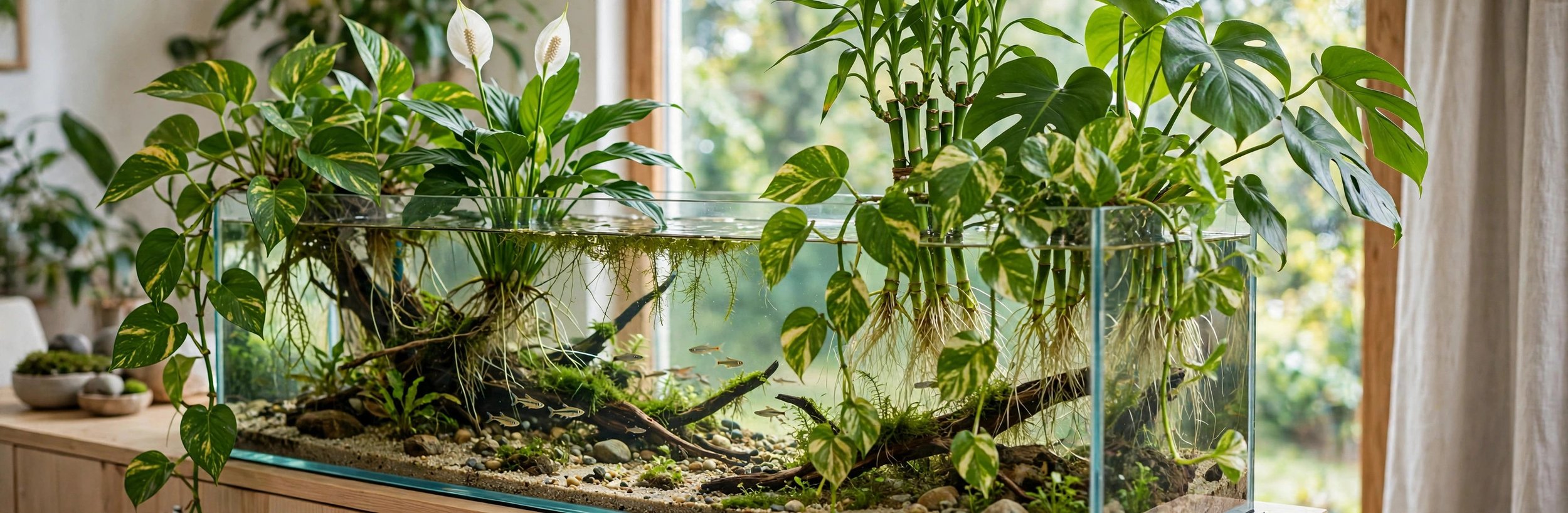
AI-generated illustration
Ask most fish keepers what changed their tank the most, and the honest answer usually isn't a new filter or a fancier light. It's a houseplant growing out of the top.
Growing plants out of your aquarium — leaves in the air, roots in the water — is called emergent (or emersed) growth, and it's the easiest upgrade in the hobby. The plant gets the room's light and CO2, the roots pull waste straight out of the water column, and you get a tank that needs less maintenance so you can spend more time enjoying it. That's the whole philosophy around here: keep it simple, let the plants do the work.
Below is the list I recommend to customers, in roughly the order I'd start them. Every one of these is a plant I either grow myself or have watched customers succeed with for years.
Why Grow Plants Out of the Top of the Tank at All?
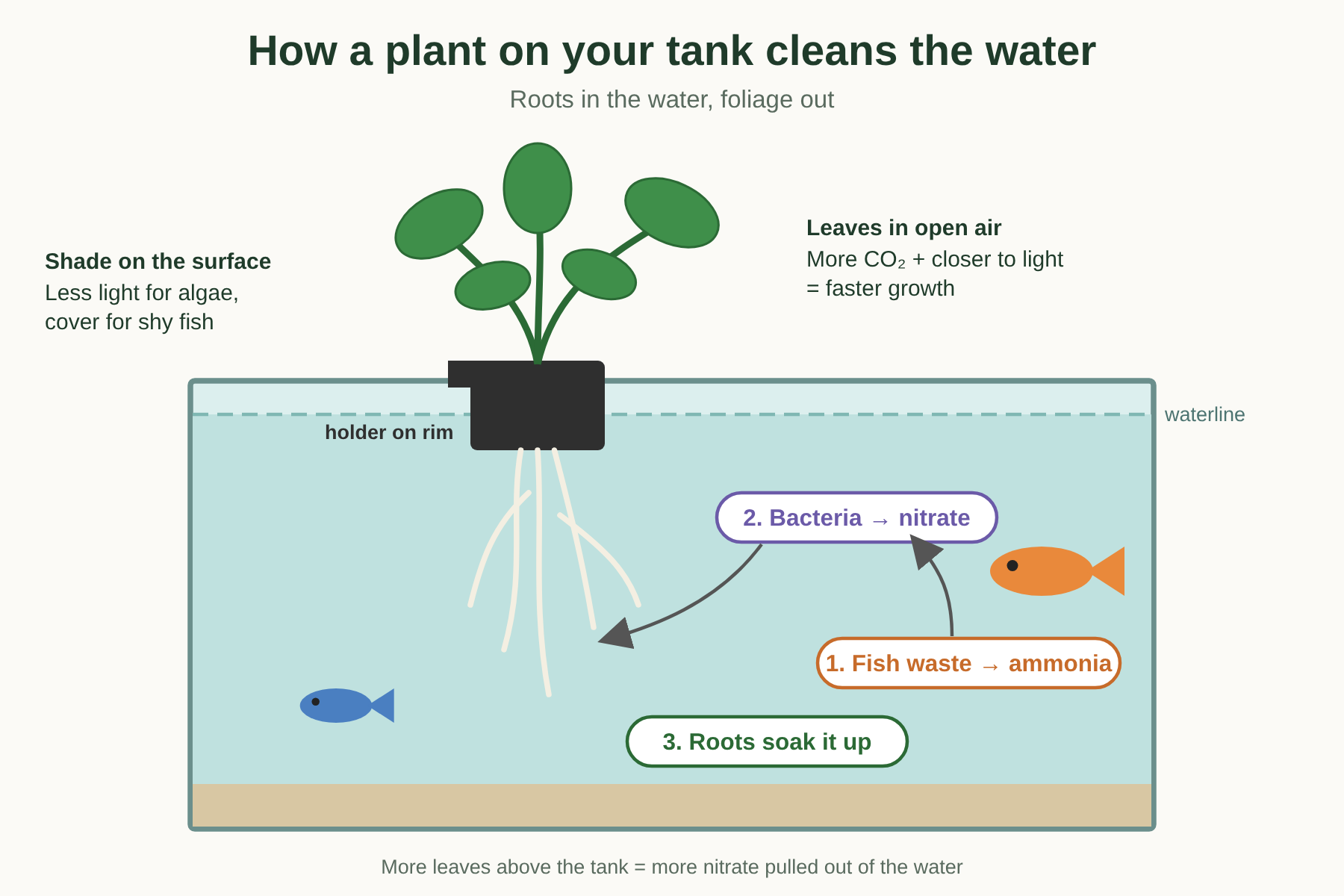
A plant growing out of the water grows faster than the same plant submerged, because its leaves breathe air. CO2 moves through air thousands of times faster than through water, so leaves in the open get a steady supply that even a well-run injected tank can't match — and they take their light straight, not filtered through a foot of water. Faster growth means the plant eats more — and what it eats is fish waste: ammonia first, then nitrate. More plant mass above the tank means lower nitrate, less algae, and more time between water changes.
The rules are the same for every plant on this list:
Roots in the water, foliage out. Leaves that sit submerged will rot and foul the water.
Wash soil-grown plants thoroughly before the roots go in, so you don't import fertilizer or potting soil into the tank. If you keep shrimp, rinse extra well — some nursery plants are treated with pesticides that are hard on invertebrates.
Give the plant something to hold onto. A plant that slips down into the tank is a mess; a plant held at the right height just grows. That's what our holders and baskets are for.
Pothos — The One Everybody Starts With
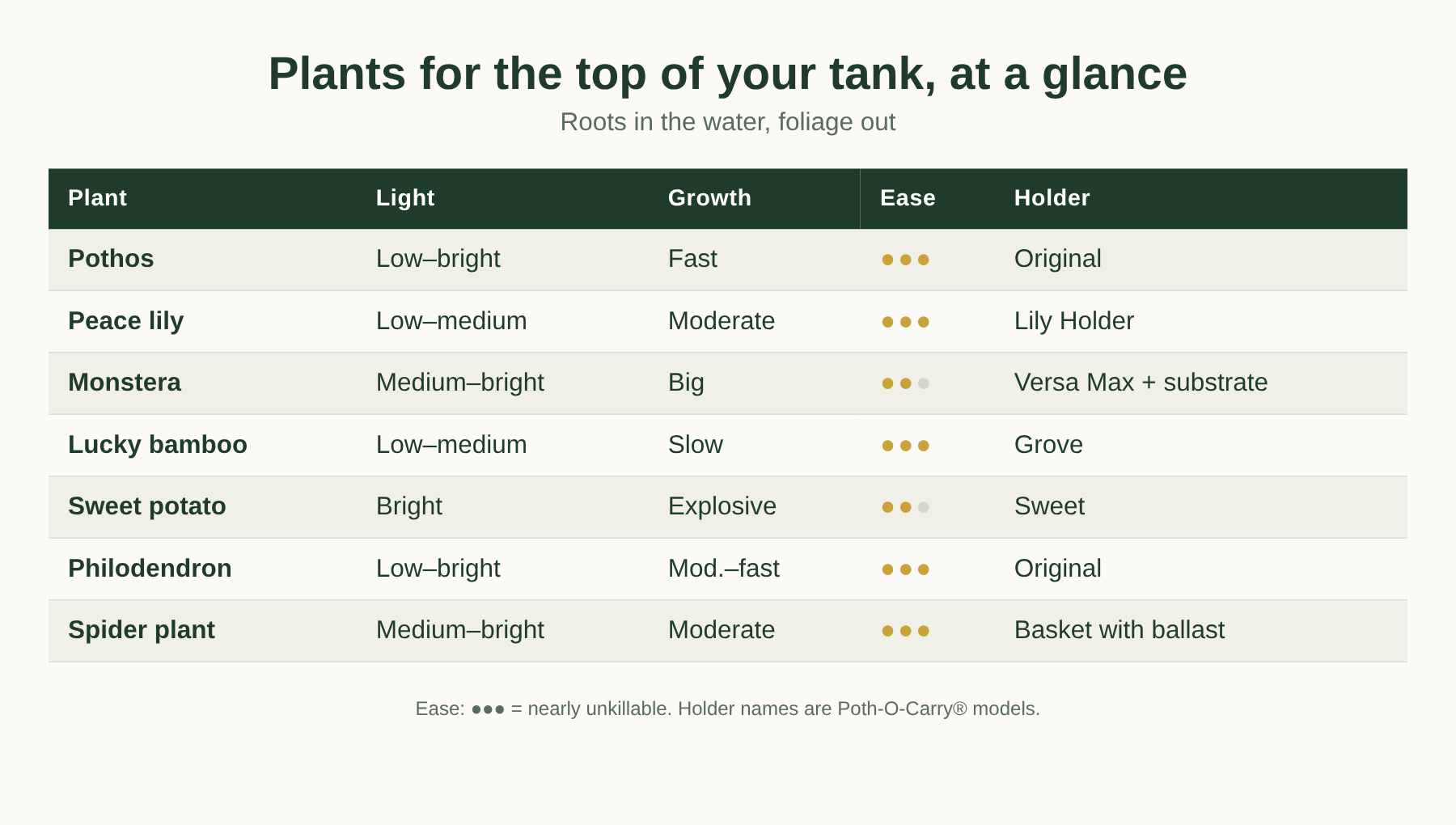
Light: Low to bright indirect. Survives almost anything; grows fastest near a window or under a tank light.
Growth: Fast. Vines can run for feet along the top of the tank.
Holder needs: Minimal. A single cutting is light, so a simple rim holder like the Poth-O-Carry® Original is all it needs. Once a vine gets long and heavy, keep it supported so it doesn't drag the cutting down.
Pothos is the gateway plant, and I wrote a whole beginner's guide to it — How to Grow Pothos in an Aquarium — because it's where most people should start. It's cheap (one grocery-store pot becomes a dozen cuttings), it tolerates low light, and it's nearly impossible to kill. On my own tanks, pothos is the backbone everything else gets added around.
Peace Lily — The Flowering Overachiever
Light: Low to medium indirect. One of the few plants on this list that prefers shade — direct sun scorches it.
Growth: Moderate. Big, lush leaves, and it will bloom above the tank when it's happy.
Holder needs: A real one. A mature peace lily is a substantial, top-heavy plant with a big root ball. It wants a wide, stable holder — that's exactly why we make the Lily Holder.
Peace lilies are the showpiece of a lot of rim gardens. The dark green leaves look like they belong over water (in the wild, they grow on damp rainforest floors, often along streams), the white blooms are a bonus, and the root mass is a nitrate sponge. Because the plant carries its weight up high, this is one where the holder matters from day one — start it in something sturdy rather than upgrading after it tips.
Monstera — The Jungle Statement
Light: Medium to bright indirect. It will grow in less, but the leaves stay small.
Growth: Slow to get going in water, then big. A happy monstera is a commitment — plan for pruning.
Holder needs: The biggest you've got. A monstera's thick stems and large leaves make it the heaviest plant most people will ever put on a rim. A wide substrate basket like the Versa Max, filled with substrate for ballast, is the right starting point.
If you want the dramatic split leaves arching over your tank, monstera is your plant — just respect its size. Start with a small cutting that has a node and an aerial root, give it the big basket from the beginning, and let it grow into the space. Moving a mature monstera into a bigger holder later is a wrestling match you only want to do once.
Lucky Bamboo — The Vertical Accent
Light: Low to medium indirect. Direct sun scorches the leaves.
Growth: Slow and steady, straight up. Years of growth, not months.
Holder needs: Tall, narrow, and grippy. The stalks need to be held upright and together — a purpose-built bamboo holder like the ones in our Grove line keeps a bundle standing straight.
Lucky bamboo (it's actually a Dracaena, not a true bamboo) is the tidy person's plant: a cluster of green canes rising straight out of the back of the tank. It's slow, clean, and nearly maintenance-free. Line several up and they form a green wall along the rim that looks deliberate even when nothing else about the tank is.
Sweet Potato — The Fast, Fun One
Light: Bright. This is the hungriest plant on the list for light.
Growth: Explosive once it wakes up. Roots in a week or two, vines within a few weeks.
Holder needs: Something that suspends the tuber with only its bottom end in the water — if the whole potato sits submerged, it rots. Our Sweet holder exists for exactly this job.
A sweet potato vine is the most entertaining plant you can put on a tank — once it gets going it grows visibly day to day, the purple or green vines are gorgeous, and the root system it drops into the water is a fry and shrimp playground. It's also a seasonal project rather than a permanent resident, which some people love. Tip: grocery-store sweet potatoes are sometimes treated to stop sprouting, so an organic one will usually start faster.
Philodendron — Pothos's Easygoing Cousin
Light: Low to bright indirect, same as pothos.
Growth: Moderate to fast, trailing or climbing depending on the type.
Holder needs: Same as pothos — a simple rim holder for cuttings (the Plus holds several stalks), more support as it fills in.
Heartleaf philodendron grows almost identically to pothos — the two get confused constantly — and it's every bit as good in a tank. Brasil and other variegated types add color. If your pothos is thriving and you want variety without new skills, this is the next cutting to root.
Spider Plant — The Baby-Making Machine
Light: Medium to bright indirect. Variegation fades in low light.
Growth: Moderate, and it produces plantlets ("babies") on long runners.
Holder needs: Medium. The mother plant is light, but a plant loaded with hanging babies pulls sideways — a Versa basket with substrate ballast or the two-point Lily Holder keeps it honest.
Spider plants give you a fountain of striped leaves and a steady supply of baby plants to move to other tanks or give away. The plantlets root happily in water too — snip one off, drop it in a holder on the next tank. Keep the crown above the waterline; only the roots go under.
A Note on the Plants Inside the Tank
Emergent plants are half the picture. Underwater, I keep it just as simple: anubias and java moss that ask for almost nothing, a patch of dwarf grass, and that's plenty alongside endlers, neon tetras, and my razorback musk turtle, Bob, in his tank with a colony of blue dream shrimp. The in-tank plants are the scenery; the plants on the rim are the filtration crew.
If you're just starting, begin with pothos. When it's thriving and you want more — more leaves, more flowers, more jungle — climb the list. And when a plant outgrows the little holder it started in, don't fight it: that's the plant telling you it's happy. Move it up to something with more room and more ballast, like the baskets in our Versa line, and let it keep going.
Frequently Asked Questions
What is the easiest plant to grow out of an aquarium?
Pothos, and it's not close. It tolerates low light, roots from a plain cutting, needs no fertilizer beyond fish waste, and forgives beginners. Start there, succeed, then expand.
Do plants growing out of the tank really lower nitrate?
Yes. Their roots absorb ammonia and nitrate directly from the water to fuel growth, and because the leaves are in the air with full access to light and CO2, emergent plants usually grow — and therefore eat — faster than submerged plants. They reduce how often you need water changes; they don't eliminate them.
Can the leaves of these plants go underwater?
No. For every plant on this list, the rule is roots in, leaves out. Submerged foliage rots, and rotting leaves foul the water you're trying to clean. Hold the plant at the right height with a rim holder or basket so the crown stays dry.
Are these plants safe around fish, shrimp, and turtles?
The roots of these common houseplants are widely kept with fish and shrimp without problems — my own tanks run endlers, neon tetras, neocaridina shrimp, and a musk turtle alongside them. Two cautions: pothos, peace lily, philodendron, monstera, and lucky bamboo leaves are toxic to cats and dogs if chewed, so keep vines out of pet reach; and watch any determined plant-nibbling fish — a plant that's being eaten should move to the filter or a protected spot.