
Every fish keeper knows the routine: test the water, watch the nitrate creep up, haul out the bucket, change the water, repeat next week. It's the treadmill the hobby runs on.
Plants are how you slow that treadmill down. Not the slow, decorative kind of "plants" that just sit in the gravel — I mean plants actively growing, especially plants growing out of the top of the tank with their roots in the water. Those plants are eating your nitrate as fast as they can grow. This post explains how that works, why emergent growth is so much faster than submerged growth, and where the limits are, because plants are powerful, but they aren't magic.
The Nitrogen Cycle in 30 Seconds
You probably know this part, but everything else builds on it, so here it is short:
Fish eat food and produce waste. Uneaten food rots too. Both release ammonia — toxic to fish even in small amounts.
Beneficial bacteria in your filter and substrate convert ammonia into nitrite — also toxic.
A second group of bacteria converts nitrite into nitrate — much less toxic, but it accumulates. Nothing in a typical filter removes it.
In most tanks, nitrate has exactly two exits: it gets diluted by water changes, or it gets eaten by plants. That's it. Every point of nitrate your plants consume is a point you don't have to dilute with a bucket.
How Roots Pull Nitrate Out of the Water
Plants need nitrogen to build leaves, stems, and roots — it's a core ingredient of chlorophyll and protein. Aquarium water hands it to them on a plate. Plant roots absorb dissolved nitrogen directly from the water column, both as ammonia/ammonium (which plants actually prefer, since it takes less energy to use) and as nitrate.
That preference is worth noticing. A plant with roots dangling in your tank isn't just mopping up the end product — it's intercepting nitrogen early in the chain, including some ammonia before bacteria ever process it. Every bit the plant takes is nitrogen that never becomes nitrate in the first place.
The exchange rate is simple: the faster and bigger the plant grows, the more nitrogen it pulls. A struggling cutting barely sips. A mature, fast-growing plant mass is a genuine piece of filtration. Which raises the question every aquascaper learns eventually: why do the plants growing out of the tank outgrow everything in it?
Why Emergent Plants Grow So Much Faster
There are three bottlenecks on a submerged plant's growth. Emergent growth removes all three.
CO2. Carbon is the main building material of a plant, and underwater it's scarce. Dissolved CO2 in a non-injected tank is low and gets used up fast; even an injected tank tops out well below what air offers. A leaf in the air is sitting in roughly 400 parts per million of CO2, available unlimited, all day. It's the difference between breathing through a straw and breathing normally.
Light. Water, glass, and depth all steal light before it reaches a submerged leaf. An emergent plant's leaves sit above all of that, closer to the lamp or window, getting the full dose.
Gas exchange generally. Along with CO2, aerial leaves handle oxygen and water vapor directly with the air. Nothing about being underwater is an advantage to a leaf — roots want water, leaves want air. Emergent growth gives each half of the plant what it actually wants.
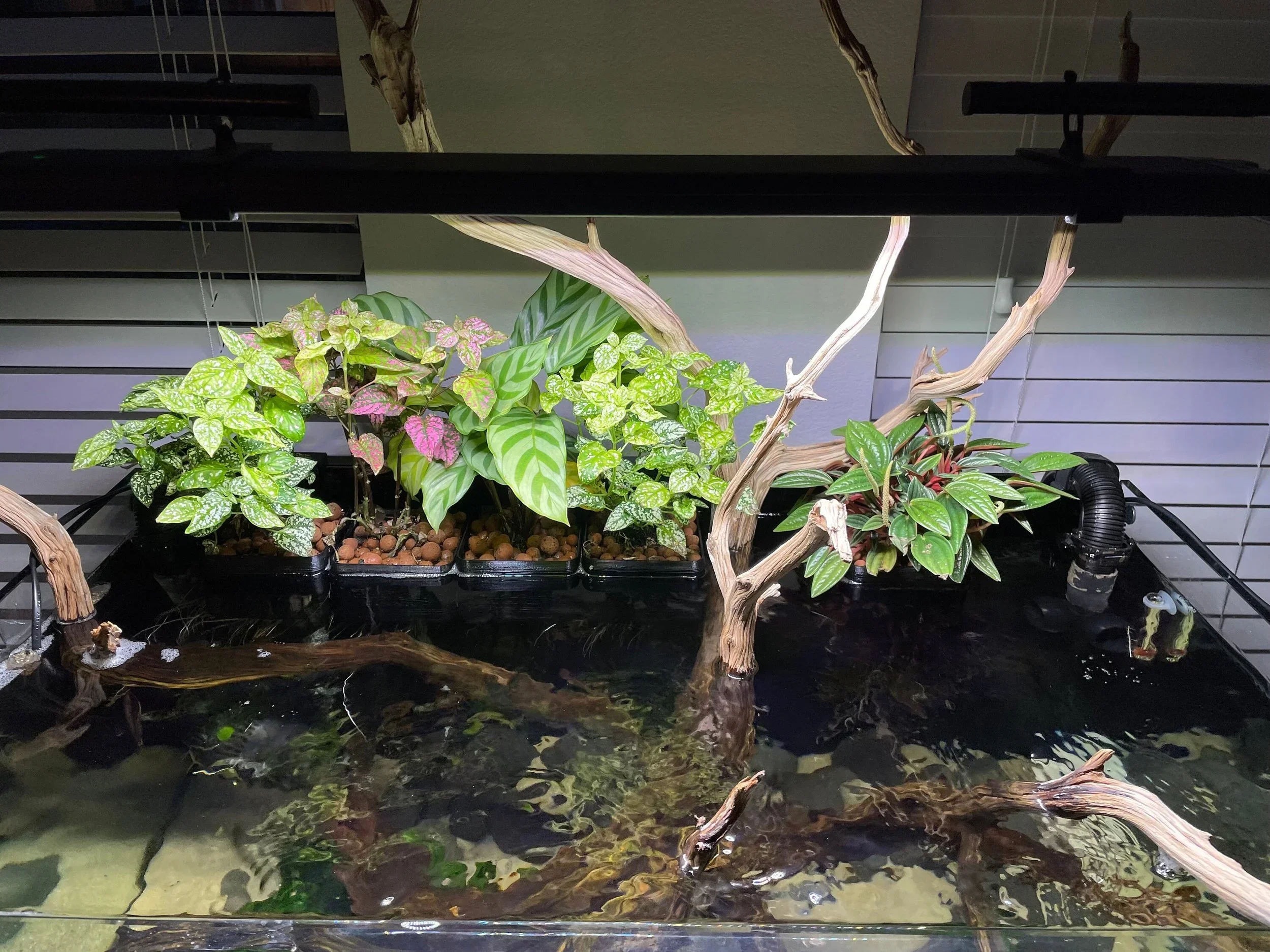
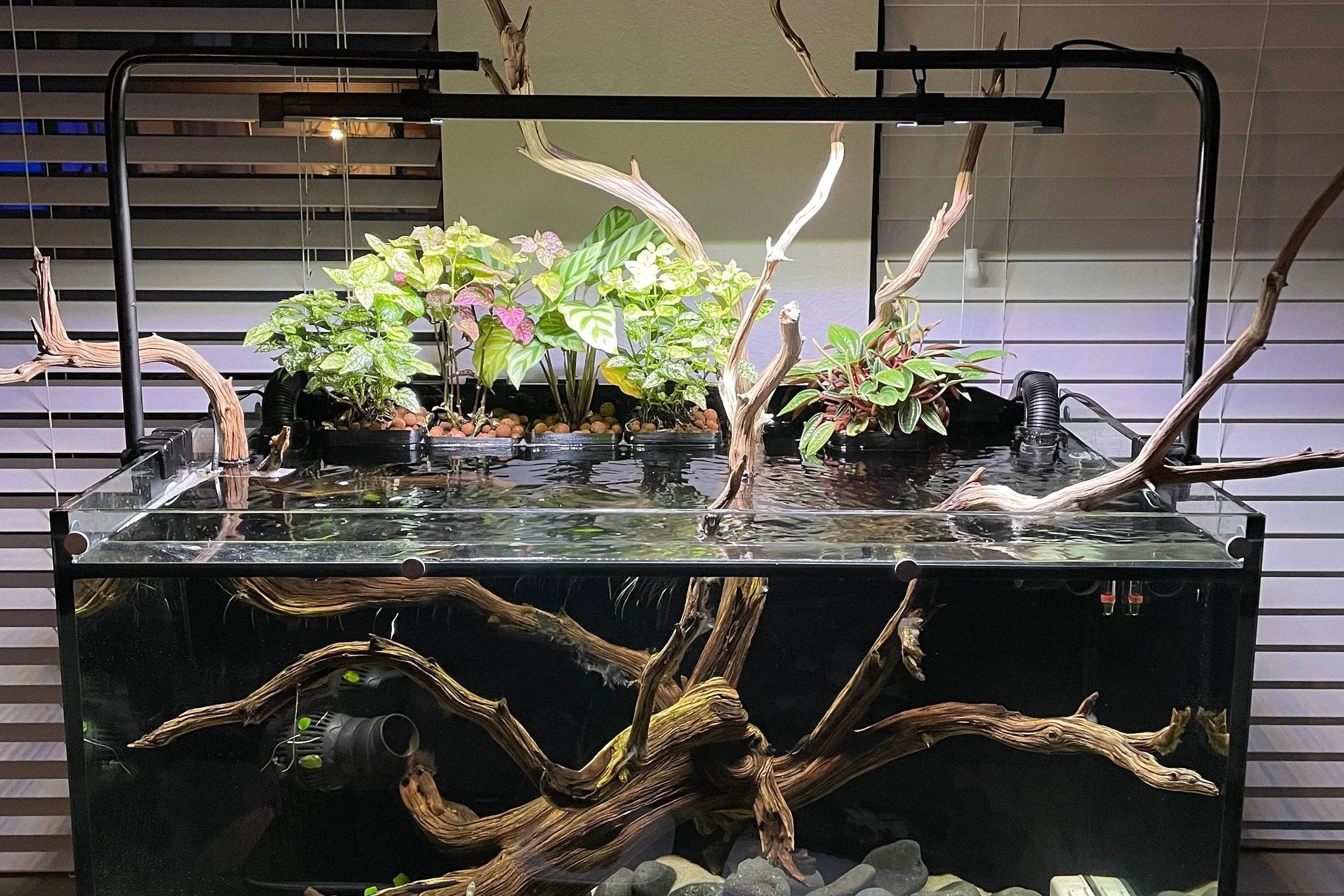
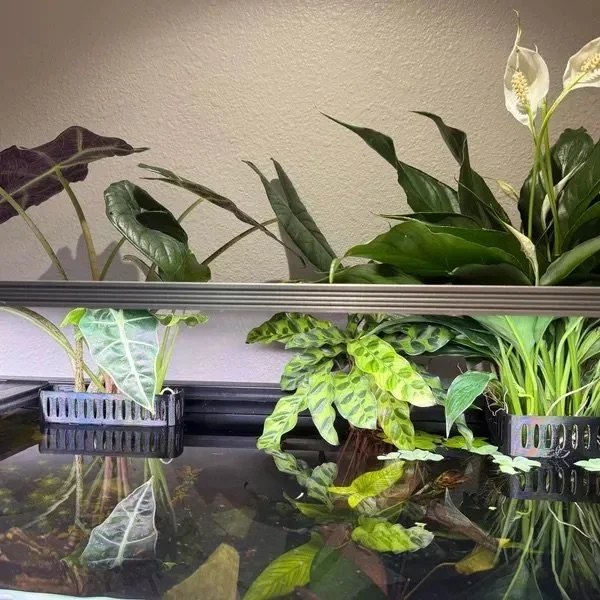
The visible result: a pothos vine trailing out of a tank will outgrow the same species planted underwater many times over. More growth = more roots, more leaves, more nitrogen uptake. This is why a cluster of houseplants on the rim — pothos, peace lily, monstera, and friends (our full plant list is here) — can move the nitrate needle in a way a few sprigs of in-tank greenery usually can't. The submerged plants in my own tanks (anubias, java moss, dwarf grass) are mostly scenery. The rim garden is the work crew.
What This Means for Stocking and Water Changes
If a plant mass is continuously exporting nitrogen, two practical things change:
Nitrate climbs more slowly. Instead of 20 ppm a week, you might see 5 or 10. The water change interval stretches — for a lot of my customers, from weekly to every two, three, or four weeks. Test kits don't lie here: add plants, keep everything else the same, and watch your nitrate curve flatten over the first month or two.
Your tank has more headroom. A heavily planted rim gives you a buffer against the small accidents of fishkeeping — a heavy feeding hand, a new fish added a bit early, a filter rinse that knocked the bacteria back. It is not a license to overstock. Think of the plants as a bigger margin for error, not a bigger tank.
The direction of travel matters too: as the plants grow in, the effect strengthens. Root systems hanging in the water also make fine habitat — fry hide in them, shrimp graze them, and my endlers treat them like an apartment building.
The Honest Limits
I'd rather talk you out of a fantasy than into a product, so here's what plants won't do:
They won't fix an ammonia spike. Plants absorb nitrogen steadily, at the pace of growth. A sudden spike from a dead fish or a crashed cycle is a water-change emergency, not a plant problem.
They won't replace your filter. The bacterial cycle still handles the ammonia-to-nitrate conversion your stocking depends on minute to minute. Plants are a second, parallel removal path, not the only one.
They need light and growth to work. A plant in a dark corner, or one that's stalled, eats almost nothing. Uptake scales with growth — a yellowing, static plant is decoration.
They don't remove everything. Plants take up nitrate, phosphate, and some metals, but water changes also replace minerals and remove things plants ignore. Even a jungle-topped tank gets water changes — just fewer of them.
Putting It to Work
You don't need a plant system. You need plant mass, light, and time. Start with a few cuttings in a holder on the rim — our Original holders were designed for exactly that first step — and let them establish. If you want the heavy artillery, bigger plants in substrate baskets like the Versa line bring a lot of leaf area to the job quickly. Test your nitrate weekly for the first couple of months and let the numbers tell you how much your interval can stretch.
Keep it simple: feed the fish, light the plants, test the water, and change it when the test says so — not just because it's Saturday.
Frequently Asked Questions
How much can aquarium plants really lower nitrate?
It depends on plant mass, light, and stocking. A lightly stocked tank with a vigorous rim garden can hold nitrate near zero between changes; a heavily stocked tank will see a slower climb rather than a stop. The honest answer is: test your tank. Most keepers see their nitrate rise cut by half or more once emergent plants establish.
Do plants absorb ammonia too, or only nitrate?
Both. Plants actually prefer ammonium because it's cheaper for them to use. Roots in the water column intercept nitrogen at every stage — some ammonia before bacteria convert it, and nitrate afterward. That early interception is part of why heavily planted tanks feel so stable.
Why do plants grow faster out of the water than in it?
Carbon and light. A leaf in air has unlimited access to CO2 (around 400 ppm) and receives full-strength light, while a submerged leaf is limited by the small amount of CO2 dissolved in water and by light lost through water and glass. Roots want water; leaves want air — emergent growth gives both what they want.
Can I stop doing water changes if I have enough plants?
No. Plants remove nitrogen compounds and some other dissolved waste, but water changes also refresh minerals and remove substances plants don't absorb. What plants buy you is a longer, safer interval between changes — fewer buckets, not zero buckets. Always let a nitrate test, not the calendar, make the final call.