
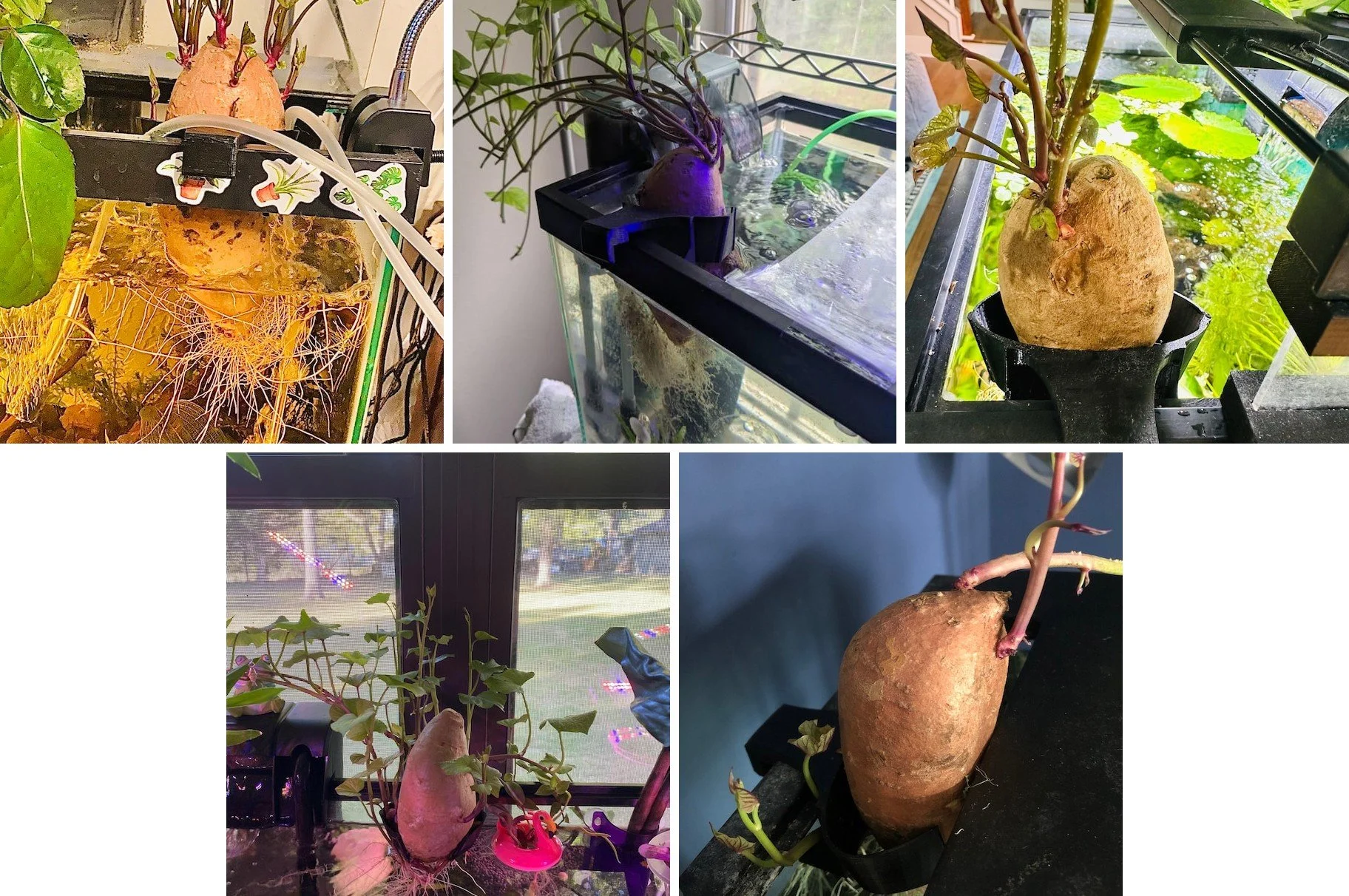
Sweet potatoes sprouting in the Poth-O-Carry® Sweet — customer photos from alex igo, Mary Clark, Danielle, mykidzrcrazy1s, and Cindy Riley.
Of all the plants you can grow out of an aquarium, the sweet potato is the one that makes people stop and stare. Hang an ordinary grocery-store sweet potato over your tank, and within a week or two it drops a curtain of white roots into the water. Within weeks you've got vines — deep purple or bright green, depending on the variety — trailing across the rim. It's fast, it's cheap, it's genuinely beautiful, and the root system it builds is one of the best nitrate sponges you can put in a tank.
It's also the plant with one classic beginner failure: rot. A sweet potato suspended wrong will turn to mush instead of a vine. This guide covers the whole job — picking the right tuber, sprouting it, suspending it so it stays dry where it needs to be dry, what to expect as it grows, and the honest truth about harvesting and eating it.
Picking Your Potato
Start at the grocery store, and be a little picky:
Choose a firm, unblemished tuber. No soft spots, no cuts, no mold. Any damage you buy is where rot will start.
Organic if you can. Store sweet potatoes don't always wake up. Some have been chilled in storage, which damages them, and some may have been treated to keep them dormant on the shelf. A tuber like that may sprout slowly, weakly, or not at all. In my experience, organic sweet potatoes sprout far more willingly.
Shape matters a little. A tuber with a clear tapered end gives you an obvious "down" end for rooting. Long, even shapes suspend more easily than round potatoes.
While you're shopping, grab two. They cost almost nothing, and having a backup means a dud tuber never ruins the project.
Sprouting: Two Ways In
Route one — sprout it on the tank. Suspend the tuber over the aquarium from day one, with the bottom tip in the water. Tank water is warm, and warmth is what a sweet potato wants to wake up. Roots usually show within a few days to two weeks, followed by sprouts (called "slips") from the top end. This is the lazy route, and it's my route.
Route two — start it in a jar. Suspend the tuber over a jar of water on a windowsill first, let it root and slip there, then move it to the tank once it's growing. This route lets you confirm you've got a live, willing tuber before it takes up rim space, and kids tend to love watching it on the counter.
Either way, the orientation is the same: pointed/narrow end down into the water, top end up in the air. If you genuinely can't tell which end is which, lay the tuber in the water bath sideways for a few days — roots will tell you which end is down.
Suspending It: Mostly Dry Is the Whole Trick
Here's the rule that makes or breaks this plant: only the bottom tip of the tuber — roughly the last half inch to inch — should touch the water. The rest of the potato stays dry, in the air.
Sweet potato skin that's kept soaking wet is an invitation to mold and soft rot. The tuber itself is a storage organ — it's built to sit in dry soil and feed the vine. It wants the roots in water and itself out of it. The old-school method is three toothpicks stuck around the middle as props across a jar rim, and it works fine for a jar. On an aquarium it's wobbly, the toothpicks give up eventually, and a tuber that slips down and soaks is a tuber that's done.
That's the problem the Poth-O-Carry® Sweet was built to solve: it holds the tuber at the side of the tank, tip in the water, body dry. The Sweet Rail Edition mounts on a rail and adds adjustable height, so you can lower the tuber as the waterline drops. Browse the whole family in our Potatoes & Bamboo category. However you suspend yours, check the waterline weekly: as the tank evaporates, top up the water or lower the tuber so the tip stays in contact.
Roots and Vines: What to Expect
Roots come first — fine white roots, thickening into a dense curtain over the following weeks. This root mass is the whole point for your tank: it's a large, fast-growing root system pulling nitrate out of the water column, the same way any emergent plant does. Fish figure it out quickly — fry hide in it, my blue dream shrimp graze it, and endlers weave through it all day.
Vines follow from the slips at the top. Expect vigorous growth — this is a bright-light plant, and with a good tank light or a nearby window the vines will run along the rim, up a trellis, or down the side of the stand. Guide them where you want them; they happily climb. Trim as needed: snipped vine tips root in water, so trimmings become new plants for your other tanks or for friends.
Light is the one demand this plant makes. A sweet potato vine in dim light grows pale, leggy, and slow — and a slow plant isn't eating much nitrate. Give it the brightest spot on the rim.
Maintenance is a five-minute weekly look. Check the tuber for soft spots or fuzzy mold (a small spot can be cut away with a clean knife; a tuber going soft all over should be retired and composted before it fouls the water). Trim roots if they reach the filter intake. That's about it.
Harvest and Edibility: The Honest Version
Let's separate the two things people mean by "harvest":
The slips are the real crop. The sprouts that grow from the tuber can be twisted off once they're 6–8 inches long, rooted, and planted in soil. Those slips are exactly how sweet potatoes are farmed — one tuber becomes many plants, and those soil-grown plants make the sweet potatoes you'd actually eat. If you have a garden, this is a lovely bonus: your fish tank started your sweet potato patch.
The tuber itself is usually spent by the time the vine has run its course — it has literally fed itself to the plant. And while a tank-grown tuber that was never exposed to fish medications or chemical additives isn't inherently dangerous, my advice is to treat the aquarium plant as an ornamental: if anything has gone into that water — meds, algaecides, fertilizers you can't account for — don't eat anything that grew in it. Grow the slips in dirt for eating. The tank tuber is a filter with leaves, and it's great at that job.
A sweet potato vine is also, honestly, a seasonal project. A tuber typically runs strong for a few months before it exhausts itself. When it fades, pull it, compost it, and start the next one for a couple of dollars. Plenty of us keep a rotation going year-round.
Frequently Asked Questions
How long before a sweet potato sprouts in a fish tank?
Roots usually appear within a few days to two weeks, with slips (the vine sprouts) following at two to four weeks. Warm water and a bright spot speed everything up. If a tuber shows nothing after three weeks, swap in a fresh one — organic if you can find it.
Why did my sweet potato rot instead of growing?
Almost always one of two causes: too much of the tuber sat submerged (wet skin molds and rots — only the bottom tip should touch water), or the tuber had damage or a soft spot when it went in. Suspend it high, start with a firm undamaged potato, and check weekly so a small spot can be cut away early.
Can fish and shrimp live with a sweet potato plant?
Yes — it's one of the best combinations going. The dense root curtain is natural cover for fry, a grazing surface for shrimp, and a playground for small fish. My own tanks run endlers, shrimp, and a musk turtle with emersed plants over them. Keep the tuber itself intact and check it regularly, since a rotting tuber is a water-quality problem for any tank.
Will a sweet potato vine take over my tank?
Above the tank, it will try — the vines are vigorous and will trail, climb, and drape anywhere you let them. That's easily managed with a weekly trim, and the cuttings root in water to start new plants. Below the waterline, the roots stay manageable as long as you trim them back from filter intakes now and then.
New to growing plants out of your tank? Start with How to Grow Pothos in an Aquarium, then see the full list in Best Plants to Grow Out of Your Aquarium.